

We're All Rational - Aren't We?
Decision-making and how someone I've never met has influenced me

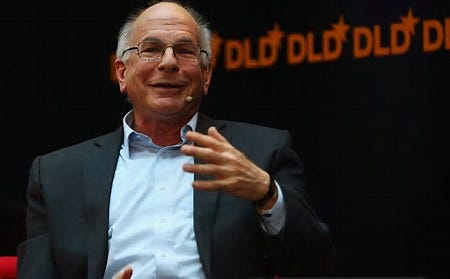
I was sad to learn last week that Daniel Kahneman had passed away at the age of 90. I’d never met, or even talked to him, but his bestselling book Thinking, Fast and Slow has had a profound effect on me.
Mr Kahneman won the Nobel Prize in Economic Sciences, despite not being an economist!! His work, on which he collaborated with Amos Tversky and drew heavily on the economic expertise of Richard Thaler and Jack Knetsch brought ‘behavioural economics’ into the wider public domain. Through many experiments, tests and reviews of the work of others, he demonstrated that contrary to our own opinions, we are very rarely rational in our thinking.
Reading ‘Thinking, Fast and Slow’ is one of those experiences where on almost every page you come across situations, biases and influences that affect our daily lives, particularly when decision-making, and think “Wow, I can remember doing that” – and usually often!
It explains how our brains take ‘short-cuts’ like substitution, and brings in previous experiences, when making decisions, and that so much of what we do is working on auto pilot. His definition of system 1 thinking (Fast) and system 2 thinking (Slow) allows the brain to manage much of our daily activity, and why we rely so much on the former.
Being aware of this, I think, has improved my ability to assess situations and to try not to react – but respond. However, I also realise that despite my best-efforts system 1 is probably still mostly in control of what I do.
I use the explanation and implications of system 1 and system 2 thinking often in my training courses – as it affects so much of what we do. As recently as last Tuesday (the day before Mr Kahneman passed away) I was referring to it at an in person event in respect of decision-making in relation to setting an achieving goals.
It strikes me as strange, that someone I didn’t know at all could have such an influence on me. Perhaps, it shouldn’t really strike me as odd as his acknowledged authority and expertise on the subject, (not only winning the Nobel Prize, and having a best-selling book, but having been in rated as one of the most influential people in global finance amongst other accolades) convinces my brain that ‘he knows what he’s talking about’, which leads me to accept his research and results as true! Another way we don’t always think rationally!!
Have you ever been influenced by someone you don’t know? Being an ‘influencer’ is apparently a thing these days – it’s a career – although it does appear to be generic and seems to be linked to product/service promotion. True influencers in my opinion don’t set out to be one. They have an idea, pursue it, work hard, and provide value as a result.
If you haven’t already had the opportunity to, I’d recommend Thinking, Fast and Slow. It isn’t always the easiest of reads, but it has enormous value, and is invariably enlightening and fascinating, all at the same time.
If you’ve enjoyed this article you can find more here
If you’d like to find out what other resources Aventina Training can offer click here
I hope you find a copy - it's a fascinating read.
Well that was a good read I now need to see if his work is in my local library - thanks Tina